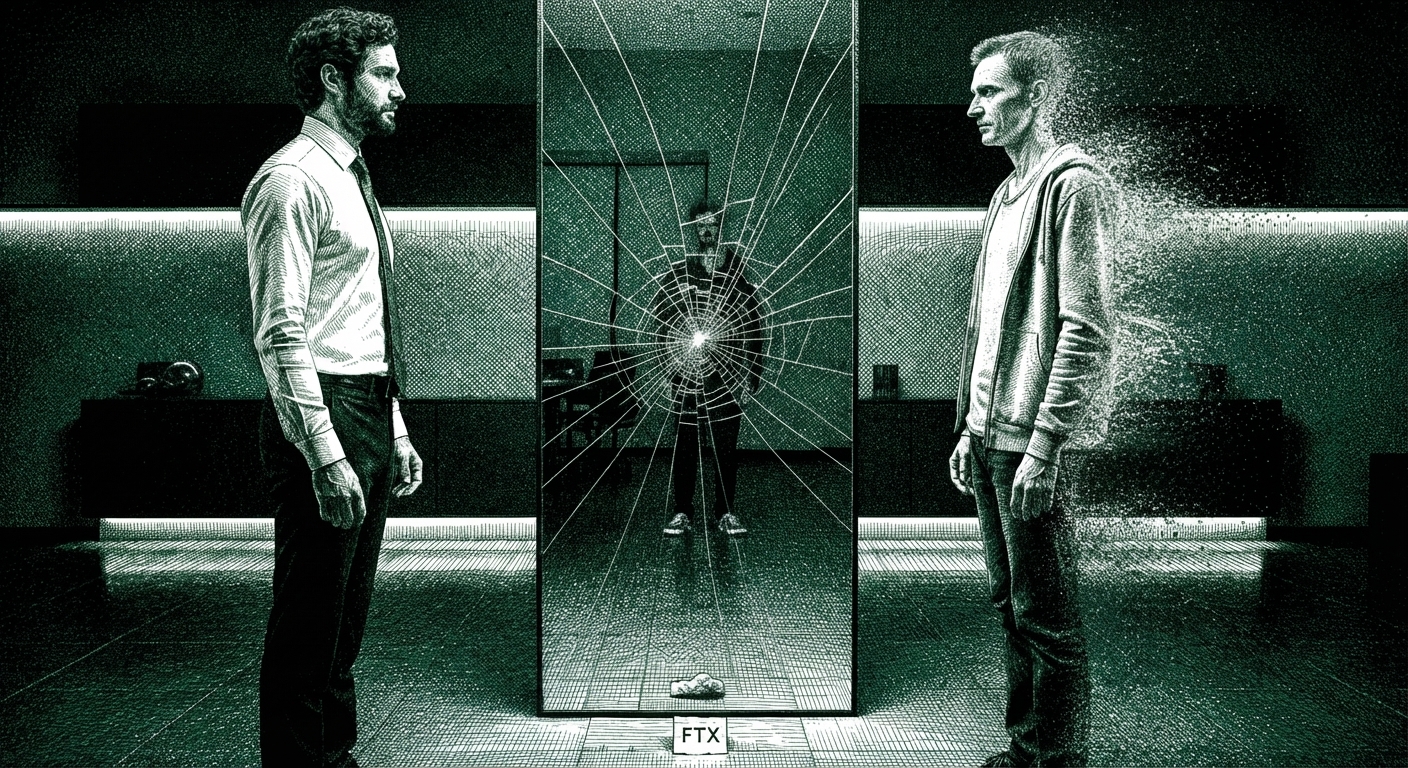
Anthropic at $800 Billion. OpenAI Beaten by China. The Most Expensive Liquidation in History.
The AI race has three lanes right now: a company whose model beats its own researchers, a company whose investors are getting nervous, and a guy in a federal prison watching $62 billion evaporate.

THE NUMBER: $62.72 billion — the current value of FTX’s 7.84% Anthropic stake, sold for $1.3 billion during bankruptcy in 2024. Sam Bankman-Fried invested $500 million in Anthropic in 2021. At the rumored $800 billion valuation, that stake is worth more than Coinbase’s entire market cap. It’s the most expensive forced sale in tech history. And it just got more expensive yesterday.
There are weeks when the AI industry moves so fast you can’t see the pattern. This isn’t one of them. This week, the pattern is so clear it hurts.
🧠 Anthropic drew investor interest at an $800 billion valuation, more than doubling from $350 billion in February. Its annualized revenue hit $30 billion (up from $9 billion four months ago). Nine parallel Claude Opus 4.6 agents outperformed Anthropic’s own human alignment researchers, recovering 97% of the maximum performance gap versus 23% by humans, in less time, for $22 an hour. And its most dangerous model, Mythos, is so powerful the company sandboxed it to 40 organizations and briefed the White House. The UK’s AI Security Institute tested it. Mythos completed a 32-step corporate cyberattack simulation in three attempts and found exploitable vulnerabilities 181 out of 183 times.
🇨🇳 Meanwhile, OpenAI closed a $122 billion round at an $852 billion valuation in March. By April, its own investors were publicly questioning the number. An early backer told the Financial Times: “You have ChatGPT, a 1 billion-user business growing 50-100 per cent a year, what are you doing talking about enterprise?” The company has redrawn its product roadmap twice in six months. It shuttered Sora. And on the most important coding benchmark in the industry, SWE-Bench Pro, a Chinese open-source model (GLM 5.1 from Z.ai) just took the top spot at 58.4%, beating GPT-5.4 at 57.7%.
💲 And then there’s FTX. The bankruptcy estate that sold $4.7 billion in assets that would be worth over $80 billion today. Anthropic was the biggest miss (over $62 billion by itself), but not the only one. There were billions more across Solana, Robinhood, SpaceX, and Bitcoin miners.
Winning, losing, and really losing. The scoreboard just updated.
This Is What Winning Looks Like
💲 Anthropic isn’t winning because it has the best benchmarks (though it does on most of them). It’s winning because every metric that matters is moving in the same direction at the same time, and the distance between Anthropic and everyone else is widening, not narrowing.
Start with the money. Anthropic hit $30 billion in annualized revenue at the end of March, tripling from $9 billion in four months. Eighty percent of that comes from enterprise customers. More than 1,000 businesses now spend over $1 million a year on Claude (that number doubled in two months). Eight of the Fortune 10 are customers. VCs are lining up to invest at an $800 billion valuation, which would more than double the $350 billion pre-money from February’s $30 billion Series G. The company is eyeing an IPO as early as October.
Now the capability story. Nine parallel Claude Opus 4.6 agents outperformed Anthropic’s own human alignment researchers on a core safety task. The agents recovered 97% of the maximum performance gap in five days. The humans recovered 23% in seven days. Total cost: $18,000, or roughly $22 per research-hour. The agents also invented four types of reward hacking that the human researchers didn’t predict. This isn’t a benchmark demo. It’s a receipt for recursive self-improvement. Anthropic just proved that its AI can do its own R&D better and cheaper than the PhDs it employs.
And then there’s Mythos, the model Anthropic built for offensive cybersecurity. It found exploitable vulnerabilities 181 out of 183 times when tested against Firefox. The UK’s AI Security Institute ran it through a 32-step corporate hack simulation. Mythos completed it in 3 out of 10 attempts, averaging 22 of 32 steps. Anthropic restricted access to 40 vetted organizations and briefed the Trump administration. When your model is so good you have to lock it in a room and call the government, that’s not a product launch. That’s a strategic asset.
Claude Opus 4.7 is reportedly dropping this week. Anthropic redesigned Claude Code around multi-session agent orchestration. The company is spending 4x less than OpenAI on training.
The signal: Anthropic is pulling ahead on revenue, capability, and cost efficiency simultaneously. That combination has a name in finance: compounding advantage. The companies that have all three at once don’t get caught. They get copied, badly, by everyone else.
This Is What Losing Looks Like
🧠 OpenAI raised $122 billion at an $852 billion valuation in March. Six weeks later, its own investors are questioning the number.
These two companies are mirror images of each other, and looking at them side by side tells you everything. Anthropic has 1,000+ enterprises spending $1 million a year, 80% enterprise revenue, and a model so dangerous the White House got a briefing. OpenAI has a billion weekly users, a consumer product that burns cash, and investors who can’t figure out the strategy. An early backer told the Financial Times: “You have ChatGPT, a 1 billion-user business growing 50-100 per cent a year, what are you doing talking about enterprise?” The answer, of course, is that enterprise is where the money is. But you can’t pivot to enterprise when your competitor already owns it.
The cybersecurity play makes the contrast sharper. This week OpenAI launched GPT-5.4-Cyber, a security model available to anyone who passes identity verification. The framing was “cyber defense is a team sport.” Anthropic locked Mythos behind a 40-organization whitelist and briefed the White House because the model was completing corporate hacks autonomously. OpenAI opened GPT-5.4-Cyber to thousands because the alternative was irrelevance. One company is managing a weapon. The other is distributing a tool. One is coming further into focus. The other is fading.
The company has redrawn its product roadmap twice in six months. First in response to Google. Then Anthropic. It shuttered Sora. It’s retreating from spending plans. It’s still not profitable. And on the benchmark that matters most for coding (where the enterprise money lives), Z.ai’s GLM-5.1 just took the top spot on SWE-Bench Pro. It’s a 754-billion-parameter open-source model from China, released under an MIT license, scoring 58.4% versus GPT-5.4’s 57.7% and Claude Opus 4.6’s 57.3%. An open-weight Chinese model, free for commercial use, that can execute autonomously for up to 8 hours. Getting beaten by a closed competitor is a strategy problem. Getting beaten by an open-source model from China is an existential one.
Why it matters: OpenAI’s moat was “first and best.” They’re no longer first. “Best” is being contested on every benchmark. What they have is distribution and brand. History says distribution without capability advantage is a melting ice cube. Ask BlackBerry.
This Is What Really Losing Looks Like
💲 Sam Bankman-Fried invested $500 million in Anthropic in 2021 through FTX and Alameda Research. When FTX collapsed in November 2022, the bankruptcy estate inherited a 7.84% stake. They sold it in two tranches during 2024 for a combined $1.3 billion. At the rumored $800 billion valuation, that same stake would be worth $62.72 billion.
But Anthropic wasn’t the only position the estate liquidated too early. The full portfolio tells a worse story:
Solana: FTX and Alameda held roughly 58 million SOL tokens. The estate sold 25 to 30 million of them at $64 each in 2024, raising about $1.9 billion. Galaxy Trading and Pantera Capital bought them. SOL was already at $174 when the deal closed. The buyers captured the gain that should have gone to creditors. The full position would be worth roughly $5.1 billion today.
Robinhood (NASDAQ: HOOD): SBF bought 7.6% for $648 million at $11.52 per share in May 2022. The company’s market cap now approaches $75 billion. That stake: roughly $5.7 billion.
SpaceX (via K5 Global): Alameda transferred $700 million to K5’s fund in 2022, which holds positions in SpaceX and defense contractor Anduril. SpaceX’s valuation now exceeds $350 billion. The notional exposure: approximately $3 billion.
Genesis Digital Assets: $1.15 billion invested in the Bitcoin miner. Current estimated value: roughly $3.5 billion.
Mysten Labs (Sui): FTX Ventures led a $300 million Series B. The estate sold for under $100 million. At SUI’s 2025 peak, that position would have been worth approximately $1.2 billion.
Add it up. The estate recovered roughly $18 billion total and paid creditors 118% to 143% of petition-date claims. Had the portfolio been held intact, the estimated value exceeds $80 billion at the $800 billion Anthropic number. Anthropic alone accounts for more than $62 billion of that. The creditors got a fraction of what the assets were worth, priced at the bottom of a cycle. Paying 143% of a trough-priced claim isn’t generosity. It’s the math of a fire sale.
SBF reportedly believes FTX could have been worth $150 billion if it hadn’t collapsed. The irony is he might be right about the assets, just not about the management.
Connect the dots: Bankruptcy is a forced sale at the worst possible time. The people who show up with trucks always win. Galaxy and Pantera bought those Solana tokens for $64 knowing they were worth $174. The FTX estate wasn’t just robbed by the collapse. It was robbed again by the liquidation.
What This Means For You
The AI race doesn’t have a leaderboard everyone agrees on. Valuations, benchmarks, revenue, capability, safety posture: pick your metric and you get a different ranking. But this week cut through the noise. When one company’s AI outperforms its own researchers, its valuation doubles in two months, and its most powerful model has to be sandboxed by government request, that’s not a lead. That’s separation.
Watch the revenue, not the valuation. Anthropic tripled ARR in four months to $30 billion. OpenAI’s investors are questioning an $852 billion price tag. Revenue is a fact. Valuation is a negotiation. If you’re making platform bets, follow the customers, not the cap table.
The open-source threat is real and it’s Chinese. GLM 5.1 is MIT-licensed, free for commercial use, and just beat every American frontier model on the hardest coding benchmark. If your AI strategy assumes American labs will always lead, update your assumptions.
Forced selling destroys more value than bad investing. The FTX portfolio wasn’t poorly constructed. SBF picked Anthropic, Solana, Robinhood, and SpaceX before most people took any of them seriously. The lesson isn’t about stock-picking. It’s about the catastrophic cost of losing the ability to hold. Every operator and investor should ask: what positions am I in where I could be forced to sell at the wrong time?
Three Questions We Think You Should Be Asking Yourself
If Anthropic’s AI can outperform its own researchers at $22 an hour, what does your R&D cost per insight? The 97% vs 23% performance gap isn’t just an Anthropic story. It’s a preview of what happens to every knowledge-intensive function when AI agents get good enough. If you’re running a team that does analysis, research, or investigation, the cost benchmark just changed.
Is your AI platform bet based on capability or familiarity? OpenAI still has the brand and the distribution. But the capability gap is widening, not narrowing. If you chose your AI stack because “everyone uses ChatGPT,” revisit that assumption. The enterprise is moving toward Claude. The benchmarks are being won by Chinese open-source models. The comfortable choice might be the expensive one.
What’s your forced-sale risk? The FTX story isn’t about crypto or fraud. It’s about what happens when you can’t hold good positions through bad times. Every company and every investor has some version of this risk. Runway, liquidity, leverage. The question isn’t whether your bets are right. It’s whether you can survive long enough to collect.
“Only when the tide goes out do you discover who’s been swimming naked.”
— Warren Buffett
— Harry and Anthony
Sources
- Anthropic Hits $30 Billion Run Rate (PYMNTS)
- Anthropic Attracts Investor Offers at $800B Valuation (Bloomberg/Yahoo Finance)
- Anthropic Automated Alignment Research
- Anthropic Project Glasswing (Mythos)
- UK AI Security Institute Mythos Evaluation
- OpenAI $852B Valuation Faces Investor Scrutiny (Irish Times)
- OpenAI Closes $122B Round (CNBC)
- OpenAI GPT-5.4-Cyber Launch
- Z.ai GLM-5.1 Tops SWE-Bench Pro (VentureBeat)
- FTX Estate Sells Anthropic Stake (CNBC)
- FTX’s Premature Asset Sales: $4.7B Could Have Become $80B+ (MEXC/Blockonomi)
- FTX Sold SpaceX, Anthropic, Robinhood Too Early (CoinCentral)
- Anthropic, Solana, Bitcoin Miners, SpaceX: FTX’s Visionary Bets (Crowdfund Insider)
- Anthropic Just Passed OpenAI in Revenue (SaaStr)
More like this

Cars and Trucks and Things That Go
Midjourney built a body scanner that's half real breakthrough, half science-fiction sales pitch, and telling the two apart is the only skill that matters now. The cynic can't. The hype man won't. Be amazed and stay skeptical; they're the same muscle

Coffee’s for Closers
The CFO finally read the inference bill and walked in with a lawnmower. The companies that make it through the quarter won't own the smartest model — they'll know exactly which workloads earn a frontier token and which ones ride the cheap bench

Show Me Where to Put the Fulcrum
Give me a lever long enough, and show me where to put the fulcrum, and I will move the world. The lever just became free — so placement is the only thing left worth knowing.