Palantir’s Alex Karp Just Called the AI Industry “Effing Insane” Here’s What He’s Really Selling You

Alex Karp Just Told You Not To Trust Your AI Vendor. He’s Also Selling You the Fix.
Palantir’s CEO diagnosed a real problem in enterprise AI. Then he handed you the invoice for the cure.
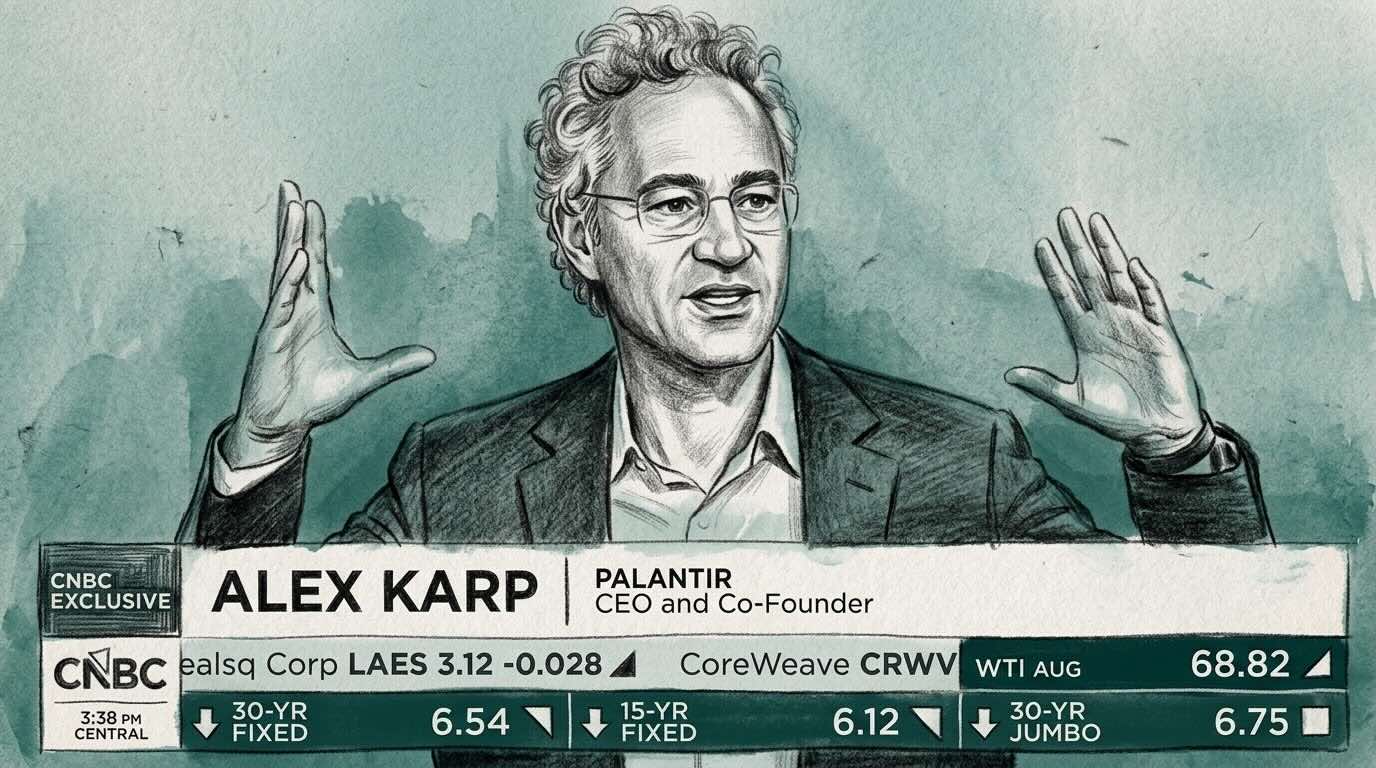
Alex Karp goes on TV and does not do small talk. In a recent interview about the Palantir-Nvidia deal, he skipped past pleasantries and went straight to a claim: the enterprises running critical infrastructure in this country don’t trust OpenAI or Anthropic anymore. Not a little. A lot. He described a “level of discomfort and loss of trust” among his clients toward the frontier labs.
Here’s the thing. He’s not wrong about the problem. He’s just also the guy who sells the solution.
The counterintuitive idea: everyone’s been debating whether AI is overhyped. Karp is making a sharper claim: it’s not overhyped, it’s mispriced, and the mispricing is a trust problem, not a capability problem.
Walk through his logic. An enterprise (a defense contractor, a hospital system, a manufacturer) plugs a large language model into its operations. That model provider now sees the company’s data, its workflows, the thing that makes the business valuable. Karp’s word for it is “alpha,” the trading-desk term for your actual edge. His question: “why would they get access to my data if they’re going to build my alpha?” Enterprises are paying per token, he says, for a service that might be quietly training the next model on the exact playbook they’re renting the model to run.
That’s the diagnosis. His prescription is what Palantir calls the “ontology”: a layer that sits between the raw model and the company’s data, so the model does the work without ever touching or caching the underlying business. “They want to know they own the means of production,” is how he put it. Own the compute, own the weights, own the data stack, own the alpha (this is the same ground we’ve covered in our reporting on the harness moat: the model is the rental, the wrapper around it is the thing actually worth owning; see also the cost thesis behind why token pricing alone never tells you who’s winning). The Nvidia deal is that idea wearing a hardware wrapper: pick any chip, any open model, and Palantir’s layer makes it behave like a frontier model without shipping your business out the side door.
We internally track this exact fight every week: Chinese labs dumping open-weight models onto the market that are good enough for most enterprise workloads, pricing frontier labs out of their own margin, enterprises quietly asking whether the $20-a-seat API call is actually cheaper than the alternative. So I read a claim like Karp’s the way I read every AI pricing argument now: is this about the technology, or is this about who gets to own the toll booth?
“These people are stealing the weights in alpha of my business…”
Alex Karp
Because here’s where it gets messy. Karp frames this as a trust crisis, almost a betrayal. “These people are stealing the weights in alpha of my business,” he says of the labs, in the same breath he calls Dario Amodei a friend he loves debating in private. That’s a serious accusation with almost no specifics attached. Using an API doesn’t hand a vendor your trade secrets any more than using AWS hands Amazon your customer list. Both OpenAI and Anthropic sell enterprise contracts with zero data retention, no training on your inputs, VPC deployment, the whole stack of guardrails Karp says nobody’s offering. He’s arguing against a version of the frontier labs that mostly stopped existing two years ago.
Here’s the part where we agree with him completely, no hedge. Somebody finally said out loud that this isn’t a hype bubble sitting on nothing. “The reality of compute plus ontology plus model change is changing the course of history,” Karp says, and he’s right. “We do not have to oversell what we have. We have.” That’s the whole ballgame. This is serious technology, working today, and any operator who picks it up with smart hands is going to win with it. I’d rather build with this stack than any tool I’ve had in 25 years of doing this, and that’s saying something after a decade racing to build VR before the market was ready for it. So when Karp says the industry’s real problem isn’t hype, it’s price, “we do not have to overhype it to the point where we’re going to have wealth tax, punishing the wealth,” that’s not a defensive line. That’s the correct diagnosis. Overhyped means the tech doesn’t work. Mispriced means the tech works fine and somebody’s charging you the wrong number for the value it actually creates. Those are two different problems, and most of the AI-bubble commentary out there still can’t tell them apart.
Where he’s genuinely right: the trust gap is real, and it didn’t come out of nowhere. Regulated industries (defense, pharma, anything touching classified or clinical data) do have a legitimate structural question about who controls a model’s weights once it’s fine-tuned on their information. An application layer that keeps a model from ever seeing raw proprietary data is a real engineering answer to a real fear, not a sales pitch invented from nothing. And the token-pricing complaint lands too: plenty of CFOs have quietly asked why they’re paying usage fees for a tool whose ROI nobody can pin down, while the vendor’s own P&L stays underwater. That’s not paranoia. That’s a normal question from anyone who’s ever signed a SaaS contract.
Where he overreaches: the leap from “I have a data-governance concern” to “this is the voice of American business that is being channeled through me” is the tell (and, ironically, the moment he sounds the least trustworthy in the whole interview). Karp isn’t reporting a market consensus. He’s building one, live, on camera, for an audience of investors he explicitly tells to go call other CEOs and check his story. That’s not journalism. That’s a founder doing what founders do: turning a competitor’s weakness into his own headline.
And that’s the self-dealing part, said plainly: Karp is the CEO of the company whose product is the exact fix for the exact problem he just diagnosed. Every plank of his argument (enterprises don’t trust the labs, enterprises need an ownership layer, that layer needs to be model-agnostic and compute-agnostic) is also, word for word, Palantir’s sales deck. He even says it himself, almost as a wink: “I’m profiting from this, right?” Give him credit for saying the quiet part out loud. Don’t give him a pass because he said it out loud.
Here’s the question underneath all of it, and it’s worth asking straight: do you actually trust the people running the frontier labs? Not the technology. The technology is real, and nobody serious argues otherwise. The leadership. A nonprofit built to keep AI safe that restructured itself to raise hundreds of billions of dollars. A CEO who calls for regulation in one breath and races past his own safety timelines in the next. Boards that get reshuffled the moment they push back. I’ve raised money from Redpoint and NEA, built and sold a company, sat across the table from investors who ask hard questions before they write a check. These founders have been on a rocket ship ride since day one, and somewhere in that climb they missed the cue that being a trustworthy person is part of the job. That’s not a conspiracy. That’s just a fact business owners have noticed, and it’s the real reason a guy like Karp gets airtime when he says out loud what a lot of CFOs are already thinking in private.
If you’re a founder or an operator listening to this interview, the useful move isn’t picking a side between Karp and the labs. It’s stealing his question and asking it of every vendor you already use, including his. Who owns the weights. Where does the data get cached. What happens to your workflow the day the vendor decides your category is the next product line. Ask it of Anthropic, ask it of OpenAI, ask it of Palantir. The answer that actually protects your business isn’t the company that yells the loudest about trust. It’s the contract terms you read before you sign.
More like this

Schools Chose AI Detection Over AI Fluency. Now Your Kid Is on Your Clock.
More than half of America’s K-12 teachers cannot tell you what their school’s policy on AI is. Not...

Which Job Gets Its 1000X Next
Somewhere out there is a developer shipping in a week what used to eat a team for a...

Treebeard Is Waking Up To AI
There is a particular kind of person you learn to distrust in business: the one who urges everyone...