
Chinese AI agent Manus is the newest breakthrough in autonomous AI technology
Manus groundbreaking achievement in creating general AI agent that is self-directing assistant that turns your thoughts into actions
Studying Manus reminds me of the early days of BabyAI from Yohei. I remember configuring a fork of BabyAGI an watching it in action—I was both shocked and excited. Now Manus evokes that same response. They’ve brilliantly leveraged freely available technology to create something truly stunning.
While AI agents like Manus are still in their infancy, this release has pushed the field forward significantly. Though this is clearly Manus’s most basic version—with more robust iterations to come—it breaks new ground. Current AI agents face a fundamental limitation: they require constant human supervision, functioning only under direct guidance. Like sophisticated puppets, they need human hands pulling their strings to animate their intelligence. Manus AI shatters this paradigm.
Developed by Chinese startup Butterfly Effect with Tencent’s financial backing, Manus positions itself as the world’s first fully autonomous AI agent. Its founder Xiao Hong, along with co-founder and chief scientist Yichao “Peak” Ji, has an impressive track record – after graduating from Huazhong University of Science and Technology, Hong founded Nightingale Technology in 2015, launched Butterfly Effect in 2022 with the successful Monica AI browser extension reaching 10 million users, and finally unveiled Manus AI in March 2025.
The distinction might seem subtle, but it’s revolutionary—imagine an AI that doesn’t just respond, but initiates, persists, and completes complex tasks without your continuous guidance.
Beyond conversation to continuous action
What separates Manus from chatbots like ChatGPT isn’t merely incremental improvement – it’s a fundamental shift in the relationship between humans and AI.
While ChatGPT excels at providing information or following step-by-step instructions, Manus operates more like a digital employee. It can break down complex projects, develop its own workflow, and execute over extended periods – even when you’re offline.
“The most impressive AI tool they’ve used,” is how experts from Hugging Face and top venture capitalists describe it. This isn’t hyperbole when you consider Manus can reportedly complete weeks of professional work in just hours.
The architecture of autonomy
Manus achieves this breakthrough through a multi-agent architecture that combines multiple AI models working in concert. This isn’t just one mind – it’s many specializations collaborating under a unified goal.
What’s fascinating is how Manus implements this multi-agent approach. When interacting with the system, users communicate exclusively with the “executor agent” – a specialized interface that doesn’t contain the details of the knowledge base, planner, or other specialized agents. This architecture brilliantly controls context length while enabling complex behaviors.
“Multi-agent implementation is one of Manus’s key features,” explains Peak from Manus AI. “Actually, it’s not that complicated. This really helps to control context length, and that’s why prompts obtained through jailbreaking are mostly hallucinations.”
Inside the sandbox
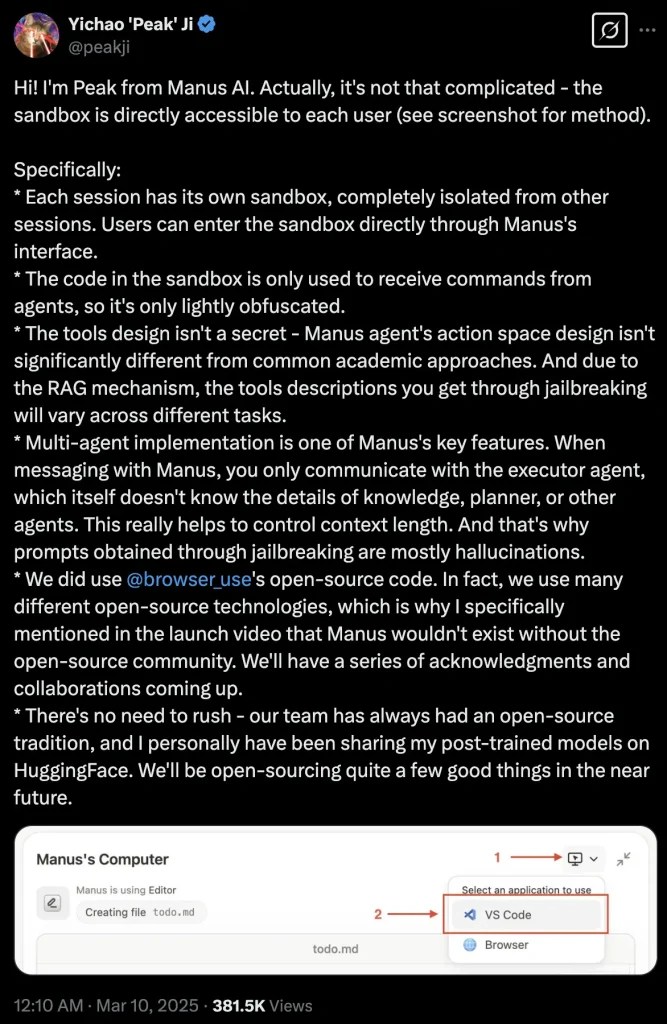
Each Manus session operates in its own sandbox environment, completely isolated from other sessions. Users can enter this sandbox directly through Manus’s interface, providing unprecedented visibility into how the AI operates.
The sandbox code primarily receives commands from agents and is only lightly obfuscated. While revolutionary in performance, Manus’s action space design follows established academic approaches rather than reinventing the wheel. Due to the RAG (Retrieval-Augmented Generation) mechanism, tool descriptions vary across different tasks.
The system integrates seamlessly with web browsers, code editors, and databases, giving it practical tools to accomplish real-world tasks. It handles text, images, and code with equal dexterity, making it versatile across domains.
Open source foundations
Perhaps most refreshing is Butterfly Effect’s commitment to the open source community. “We use many different open-source technologies, which is why I specifically mentioned in the launch video that Manus wouldn’t exist without the open-source community,” noted a company representative. This includes the well-known @browser_use open-source code among others.
The team has promised a series of acknowledgments and collaborations, with plans to open-source several components in the near future. “There’s no need to rush – our team has always had an open-source tradition, and I personally have been sharing my post-trained models on HuggingFace. We’ll be open-sourcing quite a few good things in the near future.”
The double-edged sword of true autonomy
This unprecedented level of independence raises fascinating questions. An AI system operating continuously without fatigue introduces ethical considerations that we’re only beginning to grasp.
The potential benefits are striking—picture complex data analysis running through the night, automated research gathering information as you sleep, or software writing itself to your specifications without needing constant oversight.
Yet significant challenges persist. The system’s current technical limitations lead to frequent crashes and timeouts during extended operations. Access also remains tightly controlled—fewer than 1% of waitlisted users have received invite codes.
The global AI race accelerates
Manus represents more than technological progress—it signals a shift in the global AI landscape. Through strategic partnerships, including its recent collaboration with Alibaba’s Qwen team, Manus is swiftly expanding its capabilities and reach.
This development showcases China’s rising prominence in AI innovation. While Western companies have dominated large language models, Manus marks a potential breakthrough in agent technology, advancing from conversational AI to truly autonomous systems.
Like all major technological advances, this raises important questions about ethics, security, and oversight. Yet the trajectory is undeniable—we’re moving from AI that simply responds to AI that takes initiative. Manus stands at the vanguard of this transformation.
Additional videos
Recent Blog Posts
Stop Boarding Up the Windows. The Tsunami Is Coming.
There's a popular narrative about AI and jobs right now. It goes something like this: AI is coming for your job. Companies are laying people off. The robots are winning. It's not wrong, exactly. But it's dangerously incomplete — like watching a hurricane through your living room window and thinking the problem is the wind. When a hurricane hits, the first thing you notice is the wind. Trees bending, debris flying, power lines snapping. It's dramatic and visible and it's what every camera crew points at. Then comes the rain — relentless, overwhelming, the kind that makes you question every...
Feb 24, 2026The command line didn’t die. It was waiting.
There's a moment every programmer remembers. Not when they learned to code — that's a different memory, usually involving a textbook and a lot of frustration. I mean the moment when the terminal stopped feeling like a place you visited and started feeling like a place you lived. For me, that moment happened twice. Once in my early twenties, bent over a keyboard writing Bash scripts, watching the Unix command line respond to me like a conversation. And then again, exactly one year ago, when I typed my first prompt into Claude Code and felt that same electricity — something on...
Feb 12, 2026AI and Jobs: What Three Decades of Building Tech Taught Me About What’s Coming
In 2023, I started warning people. Friends. Family. Anyone who would listen. I told them AI would upend their careers within three years. Most nodded politely and moved on. Some laughed. A few got defensive. Almost nobody took it seriously. It's 2026 now. I was right. I wish I hadn't been. Who Am I to Say This? I've spent thirty years building what's next before most people knew it was coming. My earliest partner was Craig Newmark. We co-founded DigitalThreads in San Francisco in the mid-90s — Craig credits me with naming Craigslist and the initial setup. That project reshaped...