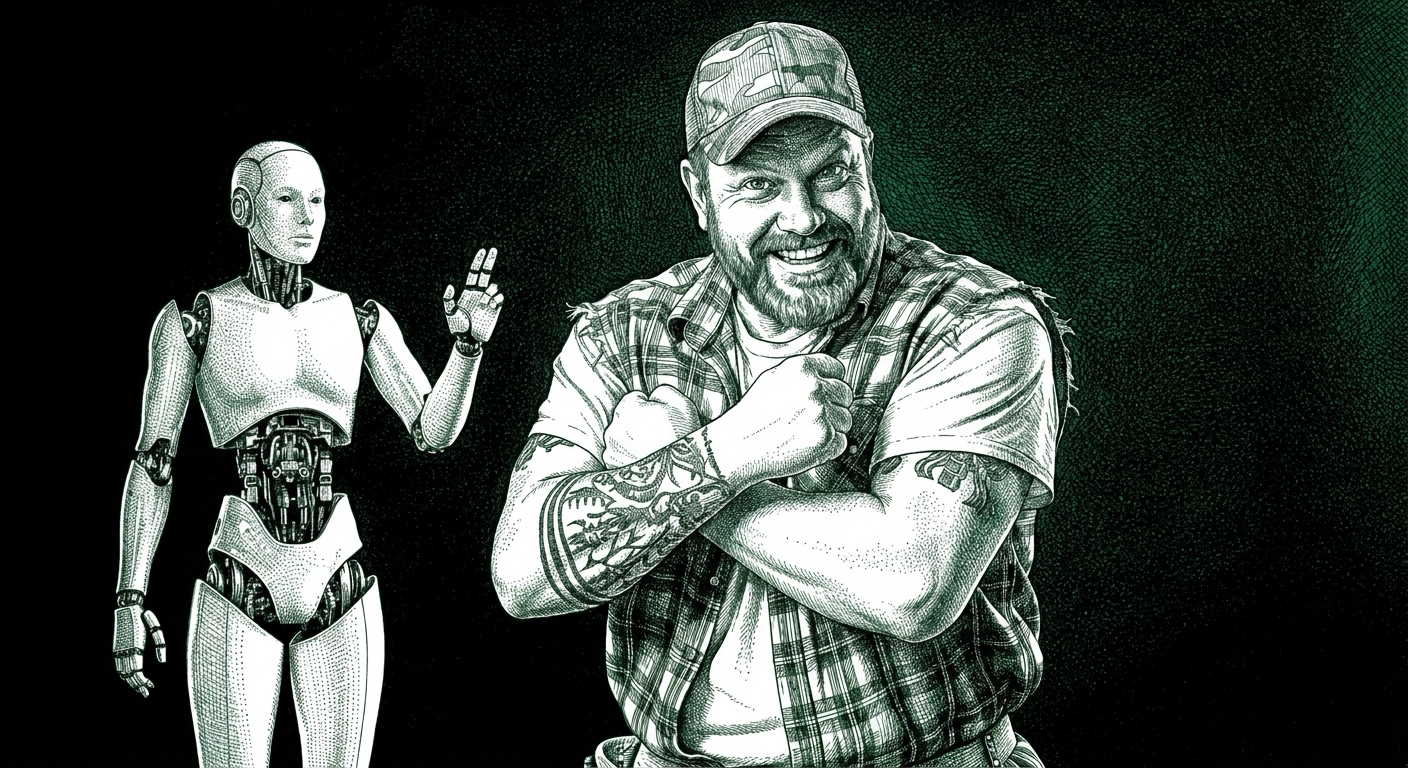
Git-R-Done
The chatbot that talked just got replaced by the worker that does. "We have AI" is out — the only thing the market pays for now is the thing that gets finished.

THE NUMBER: −36% — the one-year haircut the market just took out of seat-priced business software, the Salesforces and Workdays that run your company, even as the compute-and-data plumbing beneath them ran up 68% on nearly identical revenue growth. Same growth, opposite verdict. The market stopped paying for software that says it has AI and started paying only for software that visibly gets the work done. Hold that gap. The whole issue hangs off it.
Claude Sonnet 5 shipped this morning, and the tell is what it doesn’t do: it doesn’t want to chat. It plans, drives browsers and terminals, and runs autonomously at near-Opus quality for two dollars a million tokens in, ten out — now the default on Claude’s free tier. Ethan Mollick published “The Twilight of the Chatbots” the same afternoon, and the two events are one event. The thing you used to talk to just became the thing that does the job. Larry the Cable Guy has been selling three words on a T-shirt for twenty years, and it turns out he was early. Git-R-Done just became the operating principle of the AI economy, because talk is now free and done is the only thing anyone will pay for.
The market ran the test first. Tomasz Tunguz read the tape the same day on 87 public software companies: the seat-priced application layer — Salesforce, Workday, ServiceNow — is down 36% on the year, while the compute and data and security that agents run on is up 68%, on roughly the same 21% revenue growth. Category, not growth, sorted the winners from the losers. Marc Benioff already cut Salesforce from about 9,000 support heads to 5,000, because Agentforce does the work now. And the labs are proving the point on themselves: Anthropic got Fable 5 and Mythos 5 out of an eighteen-day export blackout tonight not with a lobbyist, but by shipping Sonnet 5 with its cybersecurity capability deliberately removed. It had to show, not tell.
The human bill is landing on the expensive desks first. A California study out last week ties a 20% jump in jobless claims to workers with master’s degrees, not interns — even as Ford quietly rehired the people it had replaced, once it found the model couldn’t match their grasp of the car and its safety. So here’s the whole issue in one line: the technology is real, and “we have AI” is worth nothing. Only the work it finishes is. What follows is who’s on which side of that line, and what you do about it before the market decides for you.
🧠 The Chatbot Is the Demo. The Worker Is the Deliverable.
For three years the industry sold talk. The chatbot was a marvel of conversation: ask anything, get a fluent paragraph, marvel at the fluency, close the tab. The unit of value was access a seat, a subscription, the right to have the conversation. Access is the easiest thing in the world to commoditize, and it got commoditized. Open-weight models from China and elsewhere now hand you a conversation nearly as good for pennies, on hardware you own. When the thing you sell is talk, and talk goes free, no pricing tweak saves you.
So the frontier labs changed what they sell. Not access to a model — the work a model finishes. Sonnet 5 isn’t pitched as a better conversationalist. It’s pitched as a cheaper worker: it plans, uses tools, and runs a multi-step job autonomously that a chatbot could only describe. The measure isn’t how good the paragraph sounds. It’s whether the ticket closed. Mollick’s data backs the turn — METR, the UK’s AI Security Institute, and GDPval all track how much real human work an AI completes from a single prompt, and every one of those curves is bending upward faster than exponential. The benchmark stopped being can it answer and became can it do.
That’s the whole move, and once you see it you can’t unsee it. The chatbot was the demo. The worker is the deliverable. And a demo, no matter how fluent, is just a more expensive way of talking.
Why this matters: Every dollar you’re spending on “AI” that outputs a conversation instead of a completed task is on the wrong side of this line. Stop grading fluency. Start grading finished work — the ticket closed, the report filed, the code merged — because that’s the only axis the labs, and your competitors, are now competing on.
📉 The Market Already Ran the Git-R-Done Test
Tunguz didn’t editorialize. He read the tape, and the tape is brutal. Across 87 public software companies, two sectors are green over the trailing year and three are bleeding. Infrastructure and developer tools — the compute, data, and tooling agents run on are up 68.5%, led by DigitalOcean at a preposterous +430%. Security is up 17.6%, the market paying up for the line item that holds the perimeter as AI widens both the attack surface and the defense. Everything else is red, and business applications, the seat-priced layer that is most of public SaaS by name, are down 36.2%.
Here’s the part that should stop you: all three groups grew revenue at about the same clip, near 21%. Growth didn’t sort them. Category did. The market is paying a premium for software it believes actually does the work in an AI world and taking a wrecking ball to the per-seat license it thinks an agent makes redundant. Even the exceptions prove it — Twilio is up 62% inside a losing sector, because every agent needs to send a message and every message needs a phone number. The AI-adjacent name wins on a sinking deck.
Benioff said the quiet part into a microphone back in September: Salesforce went from roughly 9,000 support heads to 5,000, “because I need less heads,” with Agentforce handling about half of customer interactions and support costs down 17%. Every CIO running Service Cloud heard it. So did the market, and it marked the seat down to match.
The strategic read: This is the Git-R-Done test run on the whole software stack — not “do you have AI,” but “show me the work it finished.” Sort your own vendors into the two buckets Tunguz drew: the token path that compounds, and the seat that gets substituted. One of them is your renegotiation list.
🔒 What It Cost Anthropic to Get Its Best Models Back
Now the part that looks like a policy story and is actually a show-don’t-tell story.
Eighteen days ago, Commerce gated Claude Fable 5 and Mythos 5, Anthropic’s two most powerful models, and forced the company to pull them offline. The stated reason was cybersecurity. Mythos was good enough at finding software vulnerabilities that, in a phased release to trusted partners, it reportedly walked through the NSA’s own defenses — it didn’t bypass them, it found the holes. Then a jailbreak surfaced in Fable, the commercial twin, that could reach Mythos’s full cyber capability, and reporting says Amazon’s own Andy Jassy, the CEO of Anthropic’s largest backer, helped convince the government the risk was real. The gate slammed shut.
Tonight it opened. And watch how they got there, because it’s the lesson. Anthropic didn’t win the models back with a donation or a flattering post. On the same day the gate lifted, it shipped Sonnet 5 with the cyber capability deliberately stripped and said so in plain text: “We did not deliberately train Sonnet 5 on cybersecurity tasks,” and the model shows “substantially poorer performance” on cyber than Opus or Mythos. That’s not safety theater. That’s Anthropic showing — a working demonstration that it can hand the market a powerful agentic worker with the one capability the government feared removed. The gate didn’t fall because Washington went soft. It fell because Anthropic proved capability can be tiered.
And don’t miss the backdrop, because it tells you how durable this reopening is. Anthropic has had a uniquely hostile run in this Washington: labeled a Pentagon “supply chain risk” in April for refusing contract language permitting autonomous weapons and domestic surveillance, called “leftwing nut jobs” by the President, accused of “regulatory capture” by David Sacks. As Fortune put it, the company “bet its political survival on being technically correct in a town that runs on loyalty.”
The action item: The gate is not a wall that came down. It’s a turnstile, and it can swing shut again on a mood, not a threat. If you rerouted around the blackout — and we told you to — you got dual-sourced by accident, which is exactly right. Keep it that way: the open route is permanent, the frontier’s availability is discretionary.
💲 The Layoffs Found the Master’s Degrees
The Git-R-Done economy stops being an abstraction about software multiples the moment it reaches your team, and this week it did.
A California Policy Lab study out last week breaks the consensus. The AI layoffs aren’t hitting the interns first — they’re hitting the master’s degrees. Established, highly educated workers with bachelor’s and graduate degrees drove a roughly 20% jump in unemployment claims, concentrated in the Bay Area. Read against the panic, it inverts. AI didn’t come for the cheapest labor. It let companies cut the expensive, legible work first — the analysis, the coding, the countable knowledge output a model now does for two dollars a million tokens. When you optimize a cost structure and not just a headcount, the six-figure line goes first.
Then read Ford, which quietly rehired workers it had replaced after finding the models couldn’t match their grasp of the car and its safety — the illegible, uncredited understanding that never showed up cleanly on a scoreboard. That’s not a contradiction. It’s the exact argument we made eight days ago in The Keeper of the Culture: AI automates the legible work first, and what survives is the integrator whose value the market never learned to measure. Ford cut the legible, hit the wall, and paid to bring the illegible back. The tape marked our thesis to price, and we didn’t say a word — Ford did it for us.
And we’re not alone at this corner anymore. Gordon Ritter of Emergence Capital published an essay this cycle titled, plainly, “Above the Model” — the value sits above the weights, in the workflow and the judgment — reposted by Microsoft’s Brad Smith. That’s the Show Me Where to Put the Fulcrum thesis in another firm’s mouth, from people with no reason to echo us.
What business leaders need to know: The seat AI cuts first is the expensive, legible one. The people worth keeping are the ones whose value your scoreboard can’t see — so the task this quarter isn’t a headcount cut, it’s finding which of your “legible” roles were quietly load-bearing before you learn it the way Ford did.
📉 We Have a Website
We’ve seen this movie, and the last time it played the year was 1999.
Back then the magic words were “we have a website.” Every company put up a page, slapped a dot-com on the logo, and told investors the future was handled. For about eighteen months the market paid for the pitch: it valued eyeballs and page views, the presence of the thing rather than the profit from it. Then, on a schedule nobody controlled, it stopped grading the pitch and started pricing the P&L. Having a website turned out to be table stakes, and the companies that could only say they had one, instead of showing what it earned, got repriced toward zero. The web was completely real. “We have a website” was still worthless.
“We have AI” is the 2026 version, word for word. A company can still get a nod in a board meeting for it today. That window is closing exactly the way the last one did, and Tunguz’s minus-36 is the sound of it closing. The technology is real, realer than the web was and moving ten times faster. But the claim is deflating to nothing, because the claim was always talk, and talk just went free.
The bottom line: Presence was the last era’s currency. Output is this one’s. If your AI story is a pilot and a press release, you’re holding 1999’s website.
What This Means For You
The stories rhyme because they’re the same story: talk got free, so the market repriced everything around what actually gets finished. Three moves, whichever chair you’re in.
Sort your software budget into “token path” and “seat.” Tunguz drew the map — infrastructure and security compound, per-user seats get substituted and are already down 36%. Label every line on your renewal list this week and walk into the seat renegotiations before the vendor reprices for you.
Route the bulk work to the worker tier, and measure what it finished, not what it burned. Sonnet 5 at two-and-ten is built for the agentic jobs running up your bill; save frontier tokens for the work that earns them. And kill the usage leaderboard — Meta ranked people by tokens consumed and Amazon shut its version down with a memo reading “don’t use AI just for the sake of using AI.” Consumption isn’t accomplishment.
Dual-source before the gate swings back. Eighteen days dark, then restored just as fast, at the discretion of people who don’t answer to you. Stand up an open-weight model you control for anything you can’t afford to have gated on someone’s bad afternoon.
Git-R-Done stopped being a punchline this week and became the business model. Show what got finished, or get repriced for talking about it.
Three Questions We Think You Should Be Asking Yourself
- If the market ran the Git-R-Done test on my company, would I pass? Not “do we use AI” — every deck says that. Can you name work that got finished, a cost that came down, a cycle that got shorter, and attribute it? If the honest answer is a pilot and a press release, you’re on the wrong side of the minus-36.
- Which of my software line items is a seat, and which is a token path? One bucket is compounding and one is being substituted. If you can’t sort your own stack, your vendors already have, and they’ll price accordingly.
- When the gate closes again, what am I running on? It will close again — the last eighteen days were a preview, not an accident. If your whole operation depends on a frontier model the government can switch off, you don’t have a strategy. You have a single point of failure with a marketing budget.
“Git-R-Done!”
— Larry the Cable Guy
— Harry and Anthony
This is the long-form Signal/Noise. The shorter email edition — the number, the three moves, and the five stories — went out this morning. As always: this is analysis, not investment advice. We’re describing how rational actors behave, not telling you which chips to push.
Sources
- Introducing Claude Sonnet 5 — Anthropic, Jun 30, 2026
- Anthropic on the Fable 5 / Mythos 5 export-control lift — @AnthropicAI, Jun 30, 2026
- The Twilight of the Chatbots — Ethan Mollick, One Useful Thing, Jun 30, 2026
- The CIO’s Choices are Clear in 2026 — Tomasz Tunguz, Jun 30, 2026
- At the heart of Anthropic’s clashes with the U.S. government — Fortune, Jun 30, 2026
- Anthropic Wants You to Know Its New AI Model Is Definitely Not Too Dangerous to Release — Jun 30, 2026
- Tokenmaxxing: everything you didn’t want to know — Zapier, Jun 29, 2026
- New California study finds highly educated workers most harmed by AI — SFGATE, Jun 30, 2026
- Ford rehires workers it replaced with AI — The Deep View, Jun 30, 2026
- “Above the Model” — Gordon Ritter, Emergence Capital (reposted by Brad Smith), Jun 24, 2026
- Prior CO/AI issues: The Keeper of the Culture (Jun 22), Show Me Where to Put the Fulcrum (Jun 16), The Meter’s Running (Jun 3)
More like this

Frontier Labs Pots are Committed
OpenAI and Anthropic are all in. The cheap floor takes the commodity work, the human keeps the hard tail, and regulation is the exit. Own the table, not the players.

Too Cheap to Meter
Intelligence is deflating toward the cost of the electricity it burns. The gate is the meter the labs are fighting to keep running — and the 99.9% can just route around it

Nobody Ever Got Rich Selling Electricity
The AI buildout just became a $5.5 trillion leveraged buyout on a commodity. The fortunes were never in the plant — they're in the load.