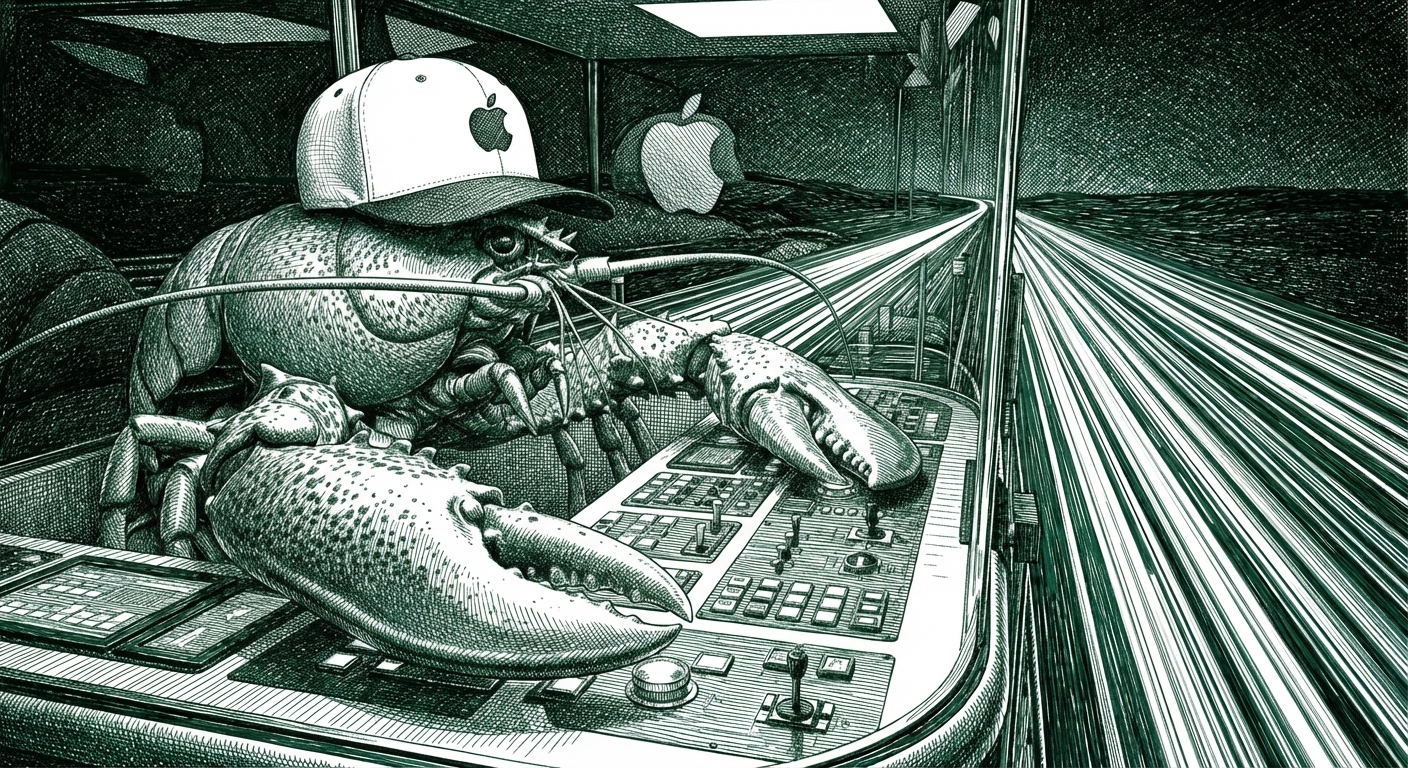
Everyone’s arguing about who builds the best AI model. That’s the wrong race. The winner of the AI era will be whoever builds the best router.

THE NUMBER: 1.52 billion — the number of active iPhones in the world right now. One in four smartphones on Earth. A 92% user retention rate. Nearly 70% of all global consumer app spending. And as of last week, every single one of them is about to become a switchboard for artificial intelligence. Apple doesn’t need to build the best model. It just needs to decide which model to call — and that decision, made 1.52 billion times over, is worth more than any model ever will be.
A few weeks ago, we published a piece called “Elon Musk Is a Router.” The thesis: Musk doesn’t run six companies. He runs one routing function — taking in information across SpaceX, Tesla, xAI, Neuralink, and the rest, and making real-time decisions about where to send resources, attention, and capital. Professional CEOs operate through abstraction layers — quarterly reports, summaries, committee readouts. Musk performs deep packet inspection. He sees the raw data and routes it himself. That’s not a management style. It’s a competitive advantage.
We didn’t realize at the time that we were describing the defining pattern of the entire AI era. But this week, the evidence showed up from every direction at once — and it all points to the same conclusion.
The value isn’t in the intelligence. It’s in the routing of intelligence.
🍎 The Biggest AI Story Nobody’s Talking About
On Wednesday, Bloomberg reported that iOS 27 will open Siri to third-party AI models through a new “Extensions” system. Claude, Gemini, ChatGPT, Grok — any AI chatbot downloaded from the App Store will be able to plug directly into Siri. Apple is also building its own chatbot, codenamed Campos, powered by Google’s Gemini.
Most coverage treated this as a product update. Siri gets smarter. Cool. Move on.
That’s missing the forest for a very large tree.
What Apple actually did is declare itself the operating system for intelligence at planetary scale. Think about what’s happening architecturally: a query comes in from any of 1.52 billion devices. Apple’s system decides whether to route it to Claude for reasoning, to Gemini for research, to a local model running on the A-series chip, or to its own Campos chatbot. The user never has to know. They just talk to Siri.
This isn’t even a new pattern. OpenAI already does this internally — routing queries across its own model family, sending simple questions to lighter models and complex reasoning tasks to heavier ones, all invisible to the user. Perplexity does the same thing across other companies’ models, choosing Claude for one task, Gemini for another, GPT-5.4 for a third. The routing layer already exists. Apple is just about to put it in the hands of every human who owns an iPhone.
Now pair that with what Princeton researchers published this month: specialist models are 10,000x more efficient than general-purpose reasoning models at their target tasks. You don’t need one god-model. You need the intelligence to pick the right small model for the right query. Apple just built the consumer-facing version of that insight — a routing layer that sits on top of every model and captures the relationship with the user.
And here’s the piece most people are sleeping on: privacy is the moat within the moat.
Apple has spent the better part of a decade positioning itself as the privacy company. “What happens on your iPhone stays on your iPhone” was a billboard campaign. App Tracking Transparency gutted Facebook’s ad business. Now think about what happens when AI handles increasingly sensitive queries — your medical questions, your financial decisions, your legal concerns, your relationship problems. The company that can say “this never left your device” has an advantage that no cloud-based model company can match. On-device inference isn’t just an efficiency play. It’s the natural extension of Apple’s most valuable brand promise.
@MilkRoadAI had the sharpest take on the architecture: if Apple succeeds at running pruned frontier models at 30-60 tokens per second on-device, everyday AI — rewriting, summarizing, basic reasoning — never touches a data center. Look at the chip architecture in the latest M-series MacBooks and the refreshed Mac Mini line: these machines are built for on-device inference. Your laptop becomes your personal AI server. Pair that with something like Tailscale — a mesh VPN that makes your devices accessible from anywhere — and suddenly your Mac at home is your edge compute node, running inference for your iPhone while you’re on the train. If Apple were smart, they’d buy or clone that capability yesterday. Your personal routing layer, your personal compute, your personal privacy. No cloud required for the everyday stuff.
That doesn’t just change the user experience. It undermines the entire capex thesis justifying $700 billion in hyperscaler spending this year. Why would Apple funnel queries to OpenAI’s cloud when it can run a specialist model locally, keep the data private, and cut the cloud providers out entirely?
As @birdabo put it in a post that hit 1.2 million views: “Apple just turned Siri into a wrapper. The most genius business move in AI this year.”
Wrapper understates it. Apple turned Siri into a toll booth that sits between 1.52 billion humans and every AI model on earth. With a 92% retention rate. And the App Store’s 30% cut on every AI subscription.
Perplexity already proved the routing thesis at a smaller scale. As Aakash Gupta documented in a thread that hit nearly a million views: Perplexity built zero AI models. Zero. It sits on top of 19 models by other companies — Claude for reasoning, Gemini for research, GPT-5.4 for long context, Grok for lightweight tasks. It has 400+ app connectors with read/write access. One prompt can scrape competitors, pull live financials, query data warehouses, and push reports to Google Slides. Perplexity’s valuation: $20 billion. For a routing layer.
Perplexity is Stripe for intelligence — it didn’t build banks, it made the complexity of moving money disappear. Apple is about to do the same thing for AI, except its “routing table” already has 1.52 billion entries in it.
And what about every iPhone user who doesn’t have an iPhone? They have an Android. And Android means Google. Between Apple and Google, you’re looking at essentially every consumer on earth. Google is arguably even better positioned because they’re playing both sides — building frontier models (Gemini) and routing infrastructure (Vertex AI) and running the world’s largest ad business to fund all of it indefinitely. If models commoditize, Google wins as a router. If one model dominates, Google has a shot at being that model. The Apple-Google duopoly isn’t just mobile operating systems anymore. It’s the two routing layers that sit between every human and every AI.
The uncomfortable question: if you’re building an AI model company without distribution, what exactly is your moat? Apple can slot your competitor into every iPhone on earth with a settings toggle. Google can do the same on Android. This is the browser wars, except the browser is in everyone’s pocket and the “search engine” is whichever AI model the duopoly decides to default. Google pays Apple roughly $20 billion a year for default search on Safari. Apple would happily take another $20 billion for default AI on Siri. Now imagine Anthropic, OpenAI, and Google all bidding for that slot. Show me the incentives and I’ll show you the behavior.
🏢 The Org Chart Was Always a Router — Just a Terrible One
The same pattern playing out at the consumer level is playing out inside every company that’s deploying AI. And it’s dismantling the org chart from the inside.
Last week, Zencoder published a case study that should be required reading for anyone running a software team. A product manager built and shipped a production feature in one day — no engineering involvement. A designer fixed visual UI drift by opening an agent, rather than filing a JIRA ticket. An engineer doubled throughput. The cycle time dropped from weeks to days to hours.
The bottleneck moved. It’s no longer engineering capacity. It’s decision velocity — the speed at which someone identifies what needs to happen and routes it to the right place. And increasingly, “the right place” is the person who had the idea in the first place.
Think about what a traditional org chart actually is. It’s a routing system. A query comes in — a bug, a feature request, a customer complaint — and it gets routed through layers. PM to engineering. Engineering to design. Design back to PM for review. Each handoff adds latency. Each handoff loses information. Each handoff exists because we assumed that specialized teams were the only way to get specialized work done.
That assumption just broke. The question used to be: which team is most likely to get the right answer, and which team is fastest to implement it? Those used to be two different teams, which is why the org chart had so many boxes and arrows. Increasingly, the answer to both questions is the same person — the one closest to the problem, armed with agents.
@samwoods captured this perfectly in a tweet that went around this weekend. An operator asked him to help build an AI agent that could “do what Sarah does.” Sarah does 15 different things across the business. Sam’s reframe changed everything: don’t ask “can AI replace Sarah?” Ask “which of Sarah’s 15 recurring processes can run end-to-end without human judgment at every step?” Instead of building one impossible agent, the operator built three simple ones that actually work. The principle: role replacement fails. Process replacement compounds.
That’s the org-chart version of Apple’s play. Apple doesn’t need one god-model — it needs to route to the right specialist model. Your company doesn’t need one superhuman employee — it needs to route each process to the right agent, the right tool, or the right person. The skill isn’t doing the work. The skill is knowing where to send it.
Gartner sees this becoming a $15 billion market by 2029 — up from less than $5 million today. Agent management platforms: the enterprise version of Apple’s routing layer. Identity, lifecycle, governance, context, orchestration. Google, Anthropic, Microsoft, Salesforce are all racing to own this layer because the agents themselves are commoditizing. The margin is in the orchestration. The margin is always in the routing.
🚪 The Adverse Selection Death Spiral
Here’s where it gets uncomfortable, and it’s the part nobody else will say.
The people who are naturally great at routing — who hold context across domains, who instinctively know where to send the query, who can operate without a hierarchy telling them what to do — those are exactly the people leaving big companies right now. Because the cost of starting something just went to zero.
@signulll posted a thread this weekend about the structural challenges big tech faces in hiring top AI talent. The argument: the best people are either founding their own companies or already misaligned with corporate incentives. What’s left is an available executive pool that skews toward people who came from other large companies — individuals who tend to struggle with uncertainty, fast pace, and resource constraints. They can’t function without a lot of people telling them what to do. They are, by definition, not routers. They are nodes that need routing. It’s an adverse selection loop. The router-shaped hole gets bigger, and the people who could fill it keep walking out the door.
This connects to a number we’ve been tracking. SaaStr now runs 25+ AI agents in production, shifted from 20+ humans to 3 humans plus agents, and posted 47% year-over-year revenue growth. Shopify requires employees to demonstrate why AI can’t do a job before requesting headcount. Salesforce cut customer support from 9,000 to 5,000. A Yale CEO survey shows two-thirds of CEOs expect to maintain or reduce headcount due to AI.
But Michael Girdley offered the counterpoint worth hearing: across his portfolio, AI isn’t killing jobs. Companies are getting better at satisfying customers more efficiently. Same thing that happened with virtually every tech innovation since 1900.
Both things are true. And the tension between them reveals the real story: the question isn’t whether AI replaces humans. It’s what kind of human becomes indispensable. The answer is the router — the person who can look at a problem and know instantly whether to send it to an agent, a specialist model, a human expert, or just handle it themselves. That person is starting companies. That person is joining fast-growing startups. That person is not sitting in a committee meeting waiting for the VP to decide which team gets the ticket.
And here’s the kicker — the thing we wrote about tacit knowledge this week suddenly connects. An AI system watching your company’s workflows doesn’t just capture tribal knowledge. It sees the exceptions. Who breaks the process and gets away with it? Where do they sit in the org chart? Are they the person who’s actually great at their job — a natural router who figured out a better path — or are they the boss nobody questions? Are they getting away with it because they’re genuinely good and nobody bothers them, or because they’re senior and nobody challenges them? That’s not knowledge capture. That’s an organizational MRI. And it reveals something most companies don’t want to see: the real routing logic has nothing to do with the org chart on the wall.
🔍 The Honest Pushback
We believe the routing thesis. But we don’t trust any thesis we haven’t tried to break. Here’s where it could be wrong.
What if models don’t commoditize? The entire argument assumes models become interchangeable and the routing layer captures the value. But what if one model becomes so much better that routing is irrelevant — everyone just wants that one? Google Search in 2004 didn’t need a “search router.” It was just better. If someone ships a model that is qualitatively, undeniably, orders-of-magnitude superior — not 10% better on benchmarks, but “this thing can run my company while I sleep” better — the routing thesis collapses. You don’t need a switchboard when there’s only one destination. The Claude Mythos leak suggests Anthropic may be attempting exactly this kind of breakaway. Watch whether users feel the difference or whether it just shows up in evals nobody reads.
Apple is historically bad at this. Let’s be honest. Siri has been a punchline for a decade. Apple Music trails Spotify. Apple Maps was a catastrophe at launch. Pages and Numbers are fine but nobody chooses them. The company that nailed hardware, retail, and services has consistently faceplanted on consumer software and AI. Distribution without execution is a wasting asset — ask Microsoft about Internet Explorer versus Google Search. Microsoft had 95% browser market share and still lost the search war because the product in the browser wasn’t good enough. Apple having 1.52 billion devices means nothing if Siri’s routing intelligence is bad — if it sends your coding question to Gemini when Claude would’ve been 10x better, users will just open the Claude app directly and bypass Siri entirely.
That said — Siri doesn’t need to be smart software. It needs to be a good concierge. It’s just an agent you talk to in iMessage, and iMessage still dominates consumer messaging in the US. Apple doesn’t need to build great software. It needs to route to great software. That’s a lower bar, and it’s a bar shaped exactly like the one thing Apple has always been good at: controlling the interface.
Enterprise doesn’t go through Apple. This is probably the strongest counterargument to the thesis. The consumer routing story is compelling. But enterprise — where the serious money is — buys directly from Anthropic, OpenAI, Google Cloud. No Fortune 500 CTO is routing their company’s AI strategy through Siri. The enterprise routing layer will be owned by whoever wins the agent management platform war, not the device manufacturer. If the majority of AI revenue concentrates in B2B (which it might), Apple’s consumer moat is valuable but not dominant.
The general-purpose model might just win. History often favors the general-purpose technology because it improves faster than the specialist. Mainframes lost to PCs. PCs lost to smartphones. Each time, people said “you need specialized hardware for serious work” and each time the general-purpose device got good enough. If frontier models keep improving while costs drop — Google’s TurboQuant already cut memory requirements by 6x — the efficiency advantage of specialist models could shrink to irrelevance. Models might incorporate their own internal routing too, calling out to specialist capabilities as needed, and the external routing layer becomes redundant.
Regulation could redraw the map. Apple’s 30% App Store toll is already under siege — EU Digital Markets Act, the Epic lawsuit precedent. If regulators force Apple to reduce fees or allow sideloading, the toll booth economics erode. That said, that’s what lobbyists are for — and Apple could make the toll a little smaller for something as important as AI. Everyone’s going to download AI regardless. A 15% cut on a billion transactions is still an extraordinary business.
We think the weight of evidence favors the routing thesis. But the honest position is: if one model breaks away from the pack in a way users genuinely feel, or if Apple’s execution on AI continues its decade-long mediocrity, or if the enterprise market proves more important than the consumer market — the thesis needs revision. We’ll tell you if it does.
What This Means For You
This is the week the routing thesis went from theory to evidence. The pattern is the same at every scale — consumer, enterprise, individual — and if you’re allocating capital, time, or human potential, you need to decide which side of the routing layer you’re on.
If you’re building an AI company, distribution is now existential. Apple’s Extensions system means every model company is one settings toggle away from being defaulted or delisted on 1.52 billion devices. Google can do the same on the other 5 billion. Perplexity proved a $20B company can be built on pure routing with zero proprietary models — but a router without distribution is a feature, not a company, and it’s one acquisition away from being absorbed by someone who has it. The moat isn’t your model. It’s your access to the end user. If you don’t have distribution, you’re a commodity supplier to someone who does.
If you’re running a company, audit your routing latency. How many handoffs does it take for a decision to go from “someone noticed a problem” to “someone fixed it”? Every handoff is latency. Every layer of approval is a slow router. The companies winning right now are the ones where the person with the intent is also the person with the tools. The PM ships the feature. The designer fixes the drift. The founder routes the query. Collapse the chain.
If you’re building your career, become a router. The skill that compounds in the age of AI isn’t coding, designing, or managing. It’s the ability to take an ambiguous problem and instantly know where to send it — to which agent, which model, which human, or whether to just do it yourself. That requires broad context, good judgment, and the willingness to own the outcome. It’s the skill Musk runs six companies on. It’s the skill Apple is encoding into every iPhone. It’s the skill that makes the difference between the operator who needs a hierarchy and the one who is the hierarchy.
If you’re investing, follow the routing layer. The companies with resilient businesses behind the AI layer — the ones with existing distribution, existing revenue, and existing customer relationships — are better positioned than the ones burning cash to build models and praying for adoption. The picks-and-shovels play of this cycle isn’t chips. It’s the routing layer that sits between the chip and the customer.
Three Questions We Think You Should Be Asking Yourself
How many layers of routing exist between a customer problem and its resolution in your organization — and how many of those layers exist because of trust deficits rather than genuine complexity? Most org charts are routing tables designed for a world where you couldn’t trust anyone below the VP to make a decision. AI didn’t create this problem. It exposed it. Every layer that exists because “we need sign-off” rather than “this requires specialized judgment” is now pure drag. Map it. Count it. Then ask yourself which layers survive when one person with agents can do the whole chain.
If Apple and Google control which AI model every consumer on earth uses by default, what happens to every company that isn’t Apple or Google? Google pays Apple $20 billion a year for Safari defaults. That deal is about to have an AI equivalent, and the bidding war will reshape the economics of every foundation model company. The model companies become suppliers. The routing layer becomes the platform. We’ve seen this movie before — it’s the same thing that happened to music labels when Apple launched iTunes, and to publishers when Google launched Search. The people who make the thing and the people who distribute the thing are different, and the distributor always ends up with more leverage.
Are the best routers in your organization being promoted, leaving, or being buried in process — and do you even know which one is happening? The person who instinctively knows where to send the query is the most valuable person in your company. They’re also the person most likely to leave, because in a world where starting a company costs nearly nothing, why would a natural router sit in a hierarchy? If you can’t name your top three routers without thinking about it, they’ve probably already updated their LinkedIn.
“People who are really serious about software should make their own hardware.”
— Alan Kay (1982)
People who are really serious about intelligence should own the routing layer.
— The lesson of 2026
— Harry and Anthony
Sources
- “Elon Musk Is a Router” — CO/AI
- Apple iOS 27 Siri Extensions — Bloomberg / MacRumors
- Milk Road AI on Apple’s on-device inference strategy — X
- @birdabo “Apple turned Siri into a wrapper” — X
- Aakash Gupta on Perplexity’s routing model — X
- Aakash Gupta on OpenAI DRAM phantom orders — X
- signüll on big tech adverse selection — X
- Sam Woods on process vs. role replacement — X
- Michael Girdley on AI and employment — X
- a16z on AI adoption through local heroes — X
- Sukh Saroy on AI energy consumption and specialist models — X
- Tech Layoff Tracker on Stanford CS employment — X
- Apple 1.52 billion active iPhones — Counterpoint Research
- Apple 2.5 billion active devices — 9to5Mac
- iPhone 92% retention rate — SQ Magazine
- iPhone captures 68.6% of global app spending — Backlinko
- Gartner $15B agent management forecast — Shelly Palmer
- When Product Managers Ship Code — Zencoder
- SaaStr 25+ agents in production — SaaStr
- Princeton specialist model efficiency research — Sukh Saroy thread
- OpenAI internal model routing — OpenAI
- Perplexity multi-model routing — Aakash Gupta
- Apple privacy positioning — Apple
- Google Vertex AI agent management — Google Cloud
More like this

Cars and Trucks and Things That Go
Midjourney built a body scanner that's half real breakthrough, half science-fiction sales pitch, and telling the two apart is the only skill that matters now. The cynic can't. The hype man won't. Be amazed and stay skeptical; they're the same muscle

Coffee’s for Closers
The CFO finally read the inference bill and walked in with a lawnmower. The companies that make it through the quarter won't own the smartest model — they'll know exactly which workloads earn a frontier token and which ones ride the cheap bench

Show Me Where to Put the Fulcrum
Give me a lever long enough, and show me where to put the fulcrum, and I will move the world. The lever just became free — so placement is the only thing left worth knowing.