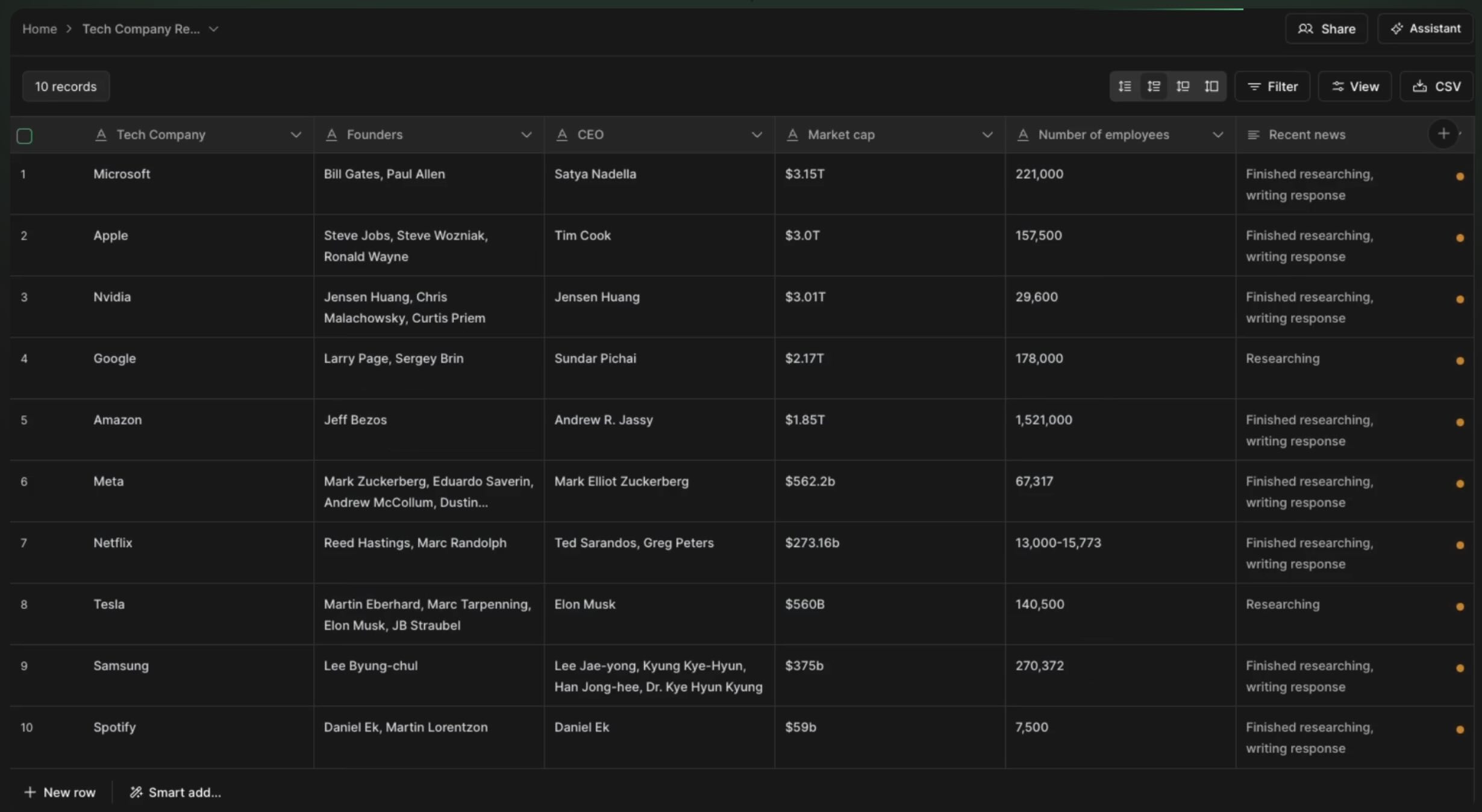
Otto’s Tabular AI: A Promising Approach to AI-Assisted Research

As an AI technology advisor constantly evaluating new AI software, I’ve just watched a product demo that has me genuinely excited. Otto has unveiled a new product that offers “a new way to interact and work with AI Agents – using tables!” This innovative approach could be a game-changer in how we conduct AI-assisted research and data analysis.

A Familiar Interface with Powerful AI Capabilities
For years, I’ve been configuring Google Sheets and more recently using ChatGPT to create AI agent-like workflows within Google Sheets, but Otto seems to be taking this concept to an entirely new level. Their implementation leverages the familiar table format to create a powerful research environment, making it intuitive for users already comfortable with spreadsheets while significantly enhancing their capabilities with AI.
Key AI Features That Stand Out
- AI Columns as Building Blocks: The demo showcased how AI columns serve as fundamental units for research capabilities, allowing for granular control and focused AI assistance.
- Intelligent Table Generation: The AI can help kickstart and build tables, streamlining the initial setup process for research projects.
- Customizable Prompts: Users can fine-tune the AI’s output using prompts, allowing for more readable and tailored results.
- Transparency and Verification: The demo mentioned the ability to verify information sources, enhancing the trustworthiness of AI-generated data.
- Task-Specific Instructions: Instead of relying solely on chat-based interactions, Otto allows users to provide specific instructions for particular tasks.
- Multimodal Input Processing: The AI can analyze videos and documents, extracting relevant information to populate the table automatically.
- Context-Aware Processing: The AI uses context from uploaded files to find specific information, potentially reducing manual effort in research significantly.
Beyond AI Chat Interfaces
What excites me about Otto’s approach is how it moves past the limitations of traditional chat interfaces and the cumbersome cut-and-paste methods we often rely on today. The demo suggests that Otto has implemented “Agent”-like features that run in the background, potentially doing much of the heavy lifting in data processing and analysis. This could be a game-changer in terms of productivity and the depth of insights we can glean from our data.
Moreover, the use of structured data in a tabular form is a smart approach, especially for users who are already comfortable working with data in spreadsheets and tables. This familiar interface, combined with powerful AI capabilities, could lower the barrier to entry for complex AI-assisted research tasks, making them accessible to a broader range of users.
Clarifications and Future Prospects
While the demo was intriguing, some aspects of the system’s capabilities need clarification. The exact extent of each cell’s capabilities, such as independent web searches or data operations, wasn’t fully clear from the demonstration. However, the demo implies that each cell can operate as its own agent, which is an exciting prospect. I’m looking forward to demoing this feature and learning how it works in practice, as it could significantly enhance the power and flexibility of the tabular AI approach.
Looking Ahead
While I haven’t had hands-on experience with the software yet (full disclosure: this review is based solely on watching demo videos, and I’m not affiliated with or compensated by Otto), I can see immense potential in this approach to AI-assisted research. It will be fascinating to see how Otto develops these features and how they compare to other AI research tools in practice.
The direction Otto has taken aligns perfectly with the growing need for more structured, transparent, and efficient AI-assisted research tools. As an AI advisor and practitioner, I’m thrilled to see innovations like this that bridge the gap between traditional data analysis methods and cutting-edge AI capabilities.
What is really cool is that AI tech isn’t the biggest innovation here – it’s the brilliant fusion of familiar spreadsheet interfaces with cutting-edge AI capabilities. Otto’s approach doesn’t just add AI to our toolkit; it reimagines how we interact with data and AI in a way that feels natural and intuitive. This could be the key to unlocking AI’s potential for a much wider audience, making sophisticated AI-assisted research accessible to those who might have been intimidated by more complex interfaces.
It’s an exciting development that I’ll be keeping a close eye on, and I eagerly anticipate the opportunity to test it hands-on in the future to fully understand its capabilities and limitations. If Otto delivers on the promise shown in this demo, it could very well reshape how we approach AI-assisted research and data analysis.
Anthony Batt is the cofounder & AI Advisor at CO/AI community, where he writes and hosts the podcast The Future Proof Podcast. You can follow him on X at @djabatt and LinkedIn.
More like this

Which Job Gets Its 1000X Next
Somewhere out there is a developer shipping in a week what used to eat a team for a...

Treebeard Is Waking Up To AI
There is a particular kind of person you learn to distrust in business: the one who urges everyone...

Claude 5 Fable Vibe Check: Anthropic Opens the Door to a Mythos-Class Model
On June 9, 2026, Anthropic did something it had spent two months publicly hesitating to do: it put...